“I’m going to quit my job and work on my business full-time!”
Ever heard of that before?
It’s what you hear in the media from the big-time entrepreneurs who supposedly gave up ‘everything’ including their well-paying job and their Ivy league degrees to start up what would eventually become billion-dollar tech giants.
And while there are some business coaches out there that encourage this because it shows ‘commitment’ and ‘forces you succeed’, I don’t share the same sentiment – even if you have an OK-sized cash cushion.
Here’s why…
Let’s Go Back In Time
It’s 2017. 5am in the morning. I’m lying awake in the bed of my studio apartment, eyes bloodshot, body fatigued. I really want to go to sleep, and I know I’ll need it because I’ve got work in about 4 hours.
But I can’t.
Instead of falling asleep, my mind is swarming with an endless cycle of thoughts:
- “Can I make next weeks’ rent?”
- “Maybe if I work this shift here, and work that job there I could meet it”
- “Fuck… I’m not sure I can make next weeks’ rent.”
- “Maybe I should just work a job that pays the bills”
- “NO! I refuse to do work that I don’t find meaningful. I don’t want to become a corporate slave and lose all meaning in my life. I know if I do something I don’t care about, I’ll be unhappy and it’ll leak over to other areas of my life. And then my life will just be miserable.”
- “There’s so many things I still need to work on in my life, and I know I need money to make it happen…”
- “I’ve done so much and sacrificed so much, why aren’t I successful already?”
- “Maybe I shouldn’t be fighting to work for money as well as what I love at the same time…”
- “What are my friends and family going to think of me?”
Each thought leading me lower and lower in the ocean of self-pity and self-doubt.
Whilst these thoughts had plagued me for quite a while, it became a lot more pronounced in the first half of 2017, when I was really struggling financially.
I mean, I’d been in 5-figures of debt before as a 20 year-old (another story for another day), but the stress I faced back then didn’t hit me as hard as this…
Money Isn’t Important For Happiness — Or So I Thought…
“Money isn’t everything”
“Money doesn’t buy happiness”
Growing up, I developed these types of mindsets towards money. Money or material things carried no significant value for me, and for the longest time I didn’t care about wearing fancy clothes / brand names, having a fancy car or house etc.
Instead, what was really valuable to me was having strong and harmonious relationships with the people around me — I won’t go into too much detail here, but long story short, I felt unworthy of being loved growing up.
And so my #1 priority as a 17 year-old about to start university, was to ‘catch up’ in my development. I focused purely on developing myself into someone ‘worthy’ of love and attention.
The way I did this was simple — get as much development in my soft skills as fast as possible. The best way I knew how to do that? Work for free.
So off I went and immersed myself in opportunities to work and gain new skills.
And from the age of 19-24, I worked for as many different causes and organisations, taking up more than 20 different roles in 17 different organisations. 12 of these roles were completely unpaid and voluntary.
I’d always believed in short-term sacrifices for long-term gain, and this was one of the many ways that I did it.
Instead of working for money in paid jobs that were easy but didn’t add to my growth, I chose to spend my time volunteering for organisations that allowed me to add value to the community and helped me grow.
And even though along the way, I sacrificed having enough money to go out with friends, go on dates, buy nice clothes and go on holidays etc., my underlying conviction to create the life I wanted in the future remained strong and intact.
My Financial “Wakeup Call”
Whilst I understood the consequences of my sacrifices and could bear the short-term pain that came along with it, after 5 years there came a point in my life where I realised I just could not keep continue working for free.
This moment came crashing down on me when I’d just come back from a 3 week education trip in Melbourne, and saw this in my inbox:
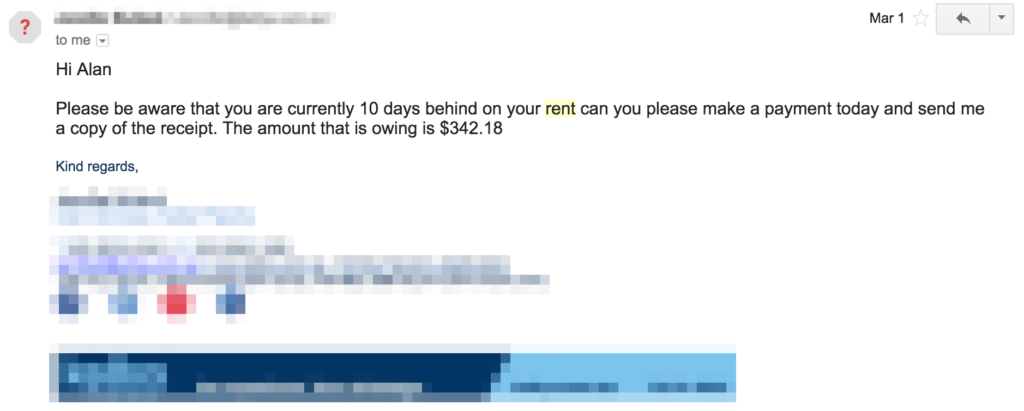
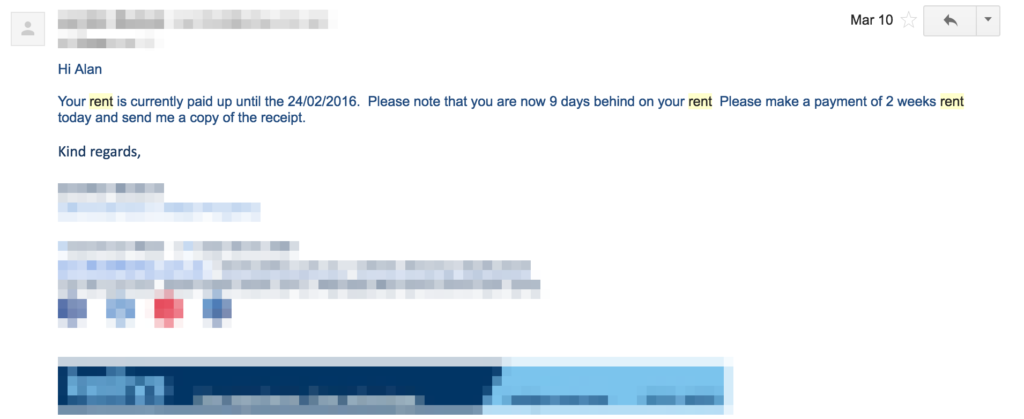
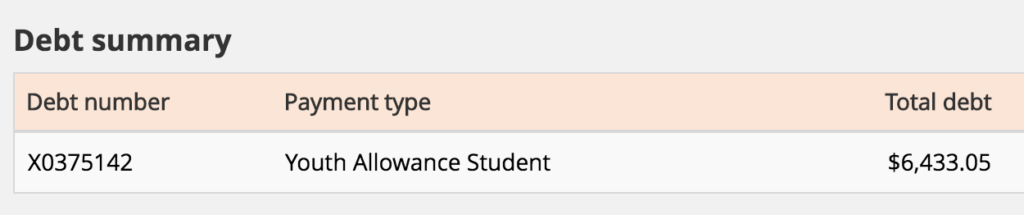
I was 3 weeks behind in rent, having spent more than half of my rainy day savings on the career bootcamp program, and was being hassled by my landlord and property manager with emails and phone calls reminding me that I was behind in rent and needed to pay up. Furthermore, I owed my welfare organisation a whopping $6,433.05.
I’d moved out of a toxic family environment more than 2 years ago, and for a while I was quite dependent on welfare payments to pay for my rental expenses. But eventually those payments stopped (I’d extended my uni degree for too long) and I had to become completely self-sufficient.
That meant I had to pay for all my expenses on my own (rent, water, gas, electricity, transport, groceries, toiletries etc.) — all of which totalled up to about $385 per week, excluding expenses for things like going out with friends, and any other expenses on top of that like computer software and website hosting, domain names etc.
I had a job working as a corporate masseur, and while it was paying me a good hourly rate, it wasn’t stable. The hours weren’t guaranteed every week, and with this situation that I put myself in, if I didn’t act quick to find stable, sufficient income, I would be homeless. Literally.
The next 2-3 months would then be one of the most difficult times I’ve ever experienced…
Pursuing Passions While Struggling Financially
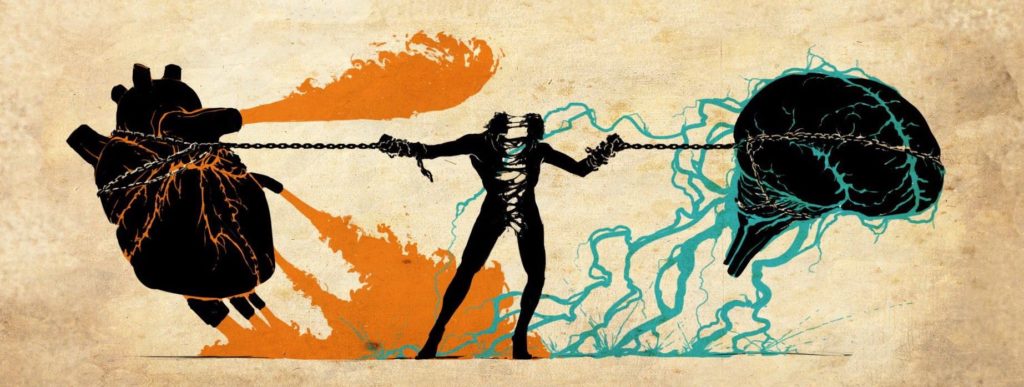
I was in serious negative cashflow while trying to balance 4 jobs to stay afloat financially whilst pursuing my passions. My original goal for 2017 was to spend a lot of my time writing for this blog, but I had put it off because it simply didn’t help meet my short-term needs. Here’s what I had on my plate instead:
Working To Stay Financially Afloat
- Marketing internship that paid me minimum wage ($18 per hour), working 2 days a week and guaranteed me $252 per week
- Corporate massage job that paid me $30 per hour, but was very inconsistent and unstable in work — I’d make between $100-$300 per week depending on how many shifts were available that week.
Pursuing My Passions For Pretty Much Free
- A contractor job working for an Internet blog that gave me access to remote work / flexibility + education relevant to my future passion
- Volunteering for an organisation that constantly demanded my time and effort in a leadership role but contributed towards my career development
Commitments I Needed To Complete
- Part-time university studies (2 subjects at the time)
- My dance crew which I had committed myself to leading for our competition, and was accountable to 20+ other people way before this all happened [note]In some ways this added more stress to my life and costed me significant amounts of time and money, but I kept it because it gave me an escape each weekend from everything else I was going through, and I’d wanted the opportunity to compete internationally really badly (I wanted to be able to tell my future children that I struggled but still made it through so they can do the same)[/note]
Family Conflict Matters — Lack Of Safety Net To Fall Back On
- My family was going through a messy situation at the time with a lot of internal strife, and I was getting caught in the middle of it
- I couldn’t move back home because there was pretty much no home to go to — the internal strife made it a very toxic environment for me to be in, and there was no way I’d go back to that after finally escaping it in 2015.
This is what my schedule looked like on a weekly basis (literally all work and no play):
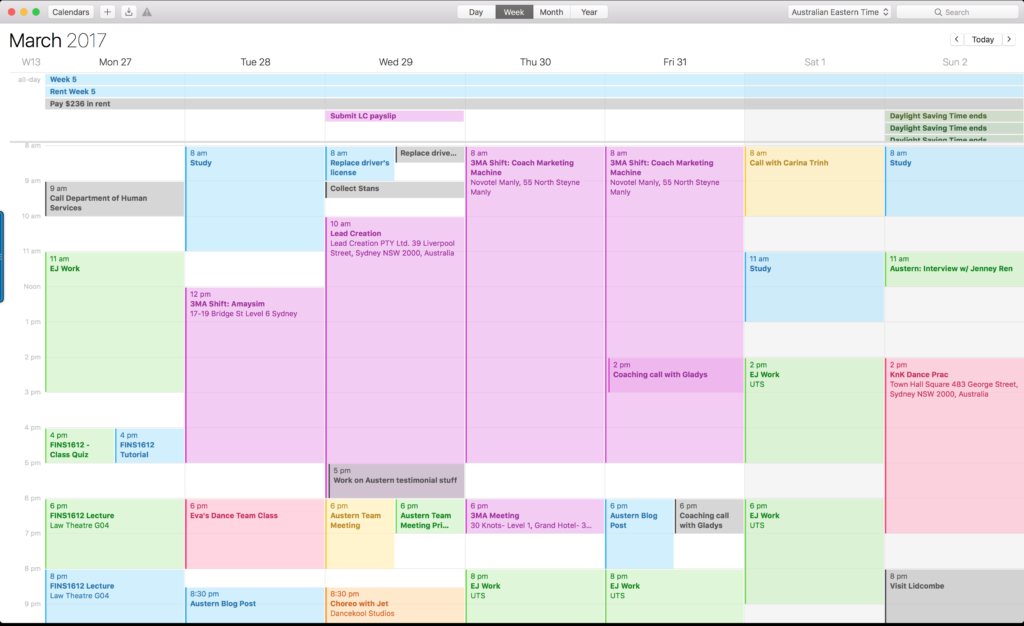
What It Actually Looked Like — Constant Reminders That Dug Into My Mind Every Day
It’s the little things that add up that eventually get to your psyche.
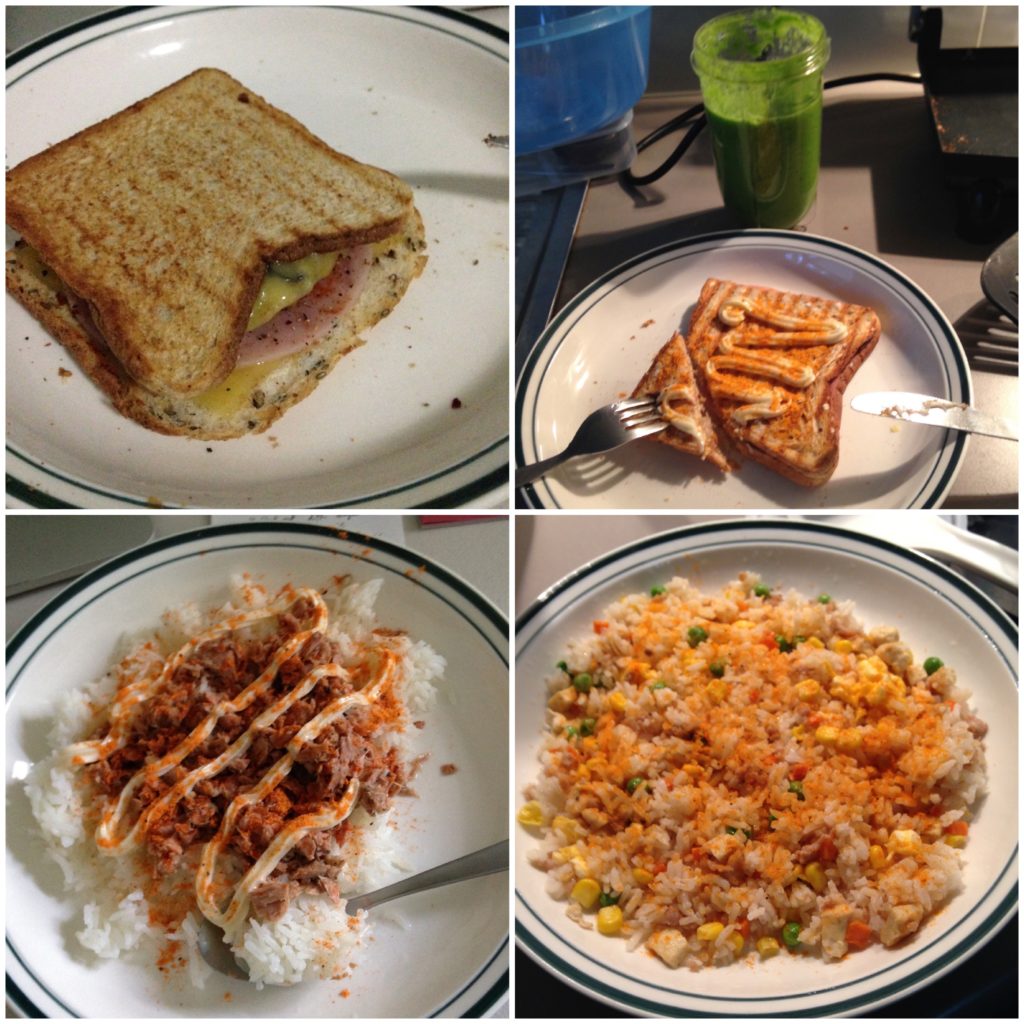
From consuming the same ham and cheese sandwiches every day, to not having enough money to pay my bills, and having to refuse going out to social gatherings with friends, every single day, I was reminded of the financial situation I was in.
On a daily basis, I ate ham and cheese sandwiches — the cheapest variety from Woolworths. Occasionally, if I started getting sick of the food, and I wanted to treat myself, I’d visit a fast food joint to buy something cheap and filling (usually that meant something greasy).
After a while I realised I wasn’t having the most nutritionally balanced diet, so I started making myself green smoothies every morning.
My rent was due every week and every Thursday, I’d be checking my bank account to see if I had enough to pay it each week.
When it arrived late, I would panic.
When it arrived on time, I’d get a sigh of relief for a few minutes, before I’d have to send it back out again. I literally saw my bank account swing between single-digits and 3-digits, coming in and straight back out.
But for most of the week, this is what I saw:
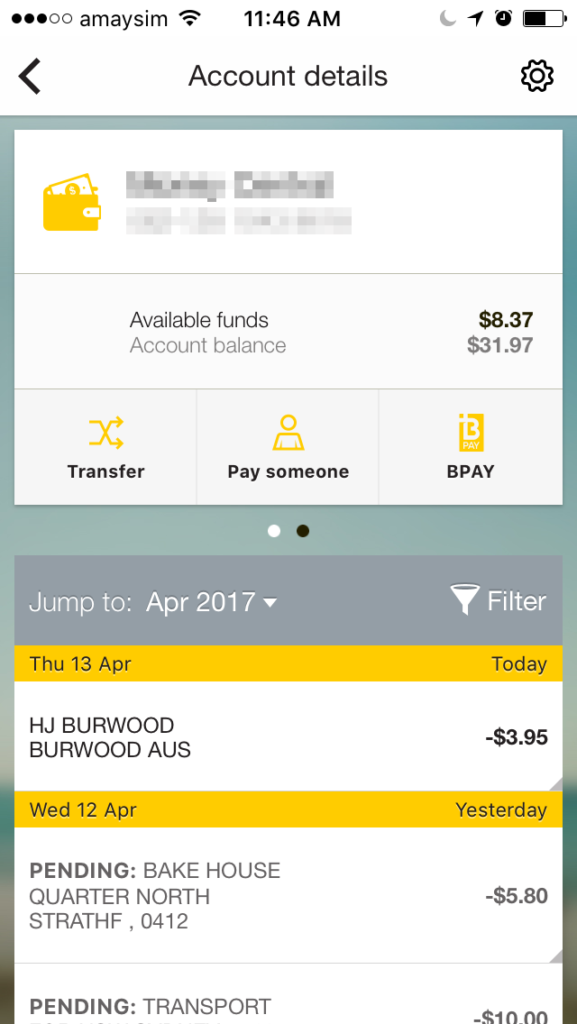
NOTE: To be fair, I also had some savings in another bank account which I’d promised myself I wouldn’t spend unless I absolutely had to. It was meant to be for investments (because I already had that long-term investment mindset at that time), and I ended up having to deplete that account to survive.
Every month, I’d get notification emails on how I didn’t have enough money in my card / bank account to pay my Internet bills:
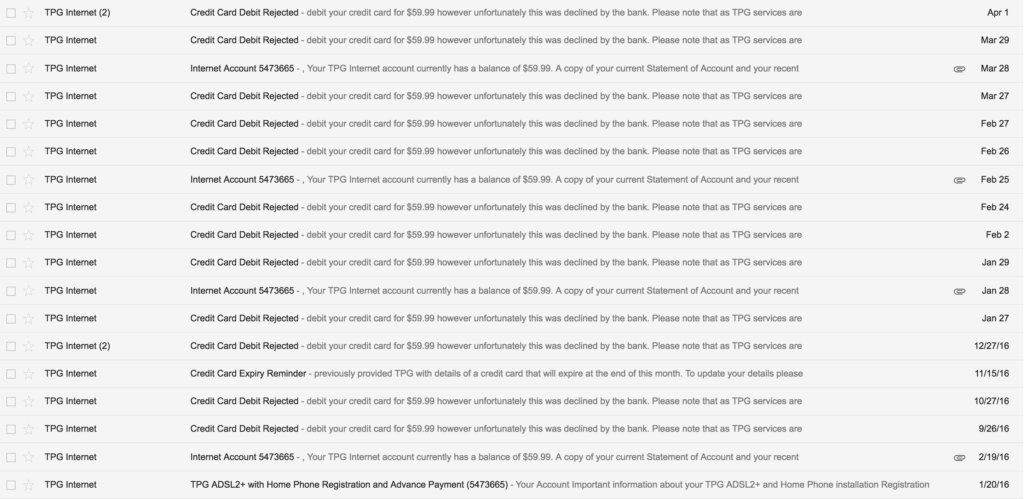
I started counting every penny that I had and was very reluctant to spend it.
Being a student of positive psychology and mindset techniques, I believed I could bear the short-term pain and stress as I went along the journey. I knew about meditation for stress relief, the power of visualisation etc.
And that worked well…. For a bit.
It started to eat away at me slowly. At first, I wasn’t too bothered by it, because it wasn’t really affecting anyone else but me.
It was my burden and my burden alone to bear. I wasn’t in a relationship, I wasn’t financially dependent on anyone else, I didn’t have a mortgage and I didn’t have kids to take care of.
But when critical areas of my life started being affected, it really, really started to get to me.
I started feeling terrible sitting at the dinner table with friends and not ordering anything to eat because I simply didn’t have the money to do so.
I started feeling terrible when people would shout me food or support me financially, only for me to feel like I was in debt to them.
I started feeling terrible when I was asked by my friends to contribute to someone’s birthday present, and I had to say no.
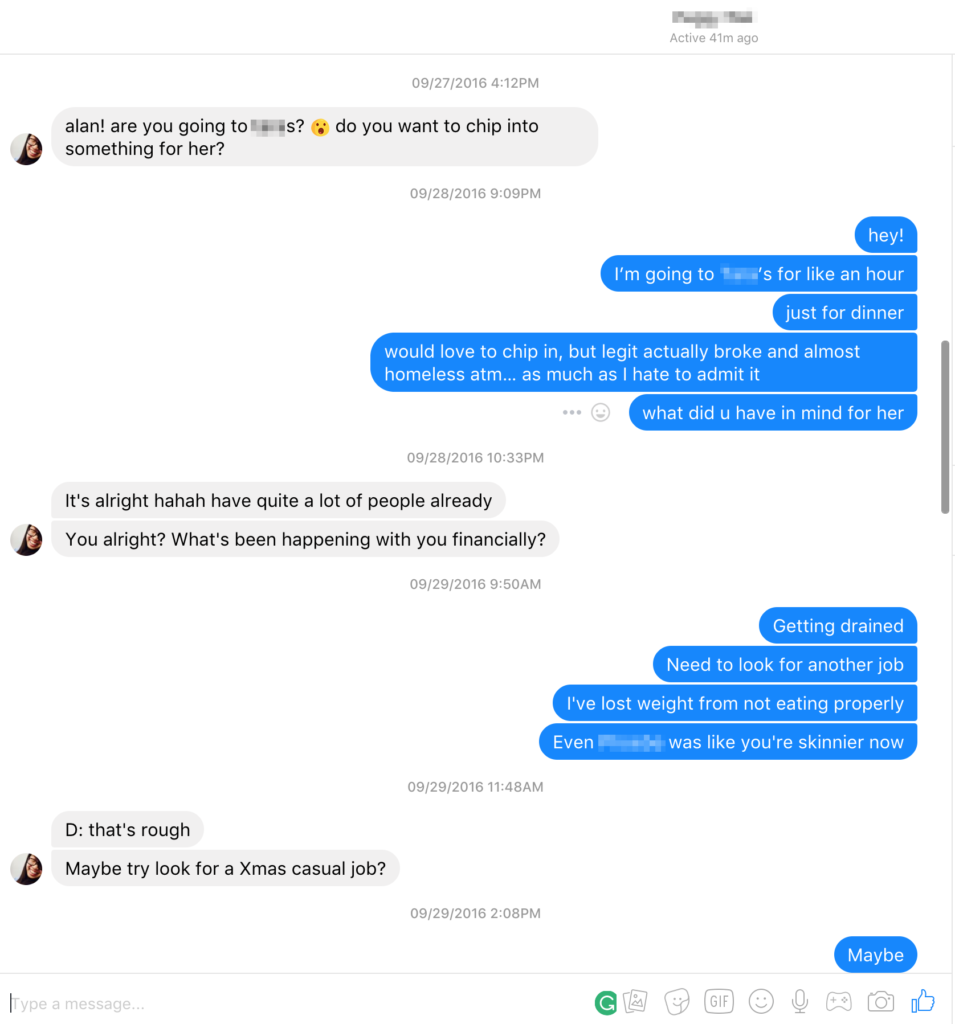
And while at first I was okay with handling it all, eventually my energy levels started to deteriorate… especially my willpower to keep negative thoughts out.
All these little factors started to hack away at my self-esteem and confidence. Bit by bit. Piece by piece.
And like getting punched in the same spot over and over again, I started to bruise, it started to hurt more and more, and I become more and more sensitive.
Until I cracked, started to bleed, and eventually broke down.
How Not Having Your Finances Together Can Affect The Different Areas Of Your Life
The financial stress that I went through affected my health in many ways and these health issues affected my life, career, relationships, and made it feel that it was impossible to ever turn things around.
Many times, I’d feel like I was fighting a battle I couldn’t win. And with no support other than myself.
1. It affects your mental and emotional health
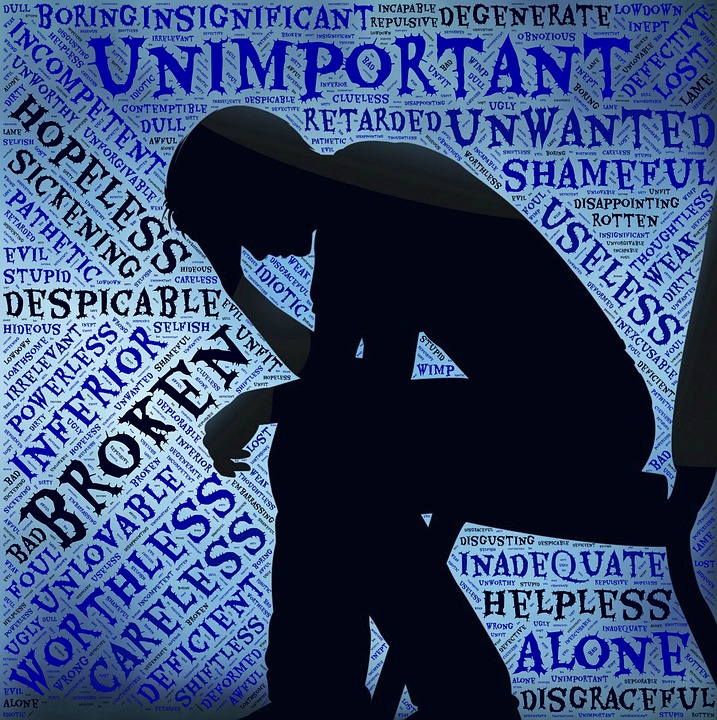
The major things I faced with regard to mental health were anxiety and depression, two conditions that go hand-in-hand and can feed off each other.
Both were debilitating conditions that made it hard to focus at work, spend time with family and friends, and keep up with my daily life.
Here’s how they manifested in my head:
I started to really doubt myself
- Having a little bit of self-doubt, I think, is important and normal.
- Before we venture into the unknown, our reptilian brain activates its safety mechanism
- But I really started to doubt myself and my ability to get out of the situation
I became a lot more negative in my filter towards the world
- On the surface I’d try to look like I had my shit together, but I could see myself start to become a lot more negative in the way I interpreted the world (more on that later)
I couldn’t stop comparing myself with my peers and thinking about how much more lucky they were than me
- How much more of a privileged and ‘normal’ life they had compared to me — to me, everyone else seemed to be free of worry from rent, had a good childhood, were supported by their families, and were able to live freely by shopping, eating out and travelling.
- I felt so much behind everyone else in life — in terms of career, relationships, and my lifestyle
- Logically I knew this was stupid because I’m so damn privileged just to be able to write about my experiences in this blog here, but on an emotional level it was taxing.
It was difficult for me to cut out some ‘slack time’ for fun
- I felt like I needed to be using every bit of my time to reverse my financial situation.
- I started laughing less, and was always on ‘work mode’ — much to the disappointment / annoyance of a few friends who’d always seen me as the fun person to be with.
I became self-critical and very harsh on myself
- And as a result, became overly sensitive to criticism (more on that later)
- At times when you’re on your own, being self-critical is the last thing you need
- It became very difficult to love myself
My mind was constantly racing with unwanted, and often very dark thoughts
- Coming from a background of teenage depression, it wasn’t very difficult for me to slip back into my self-destructive thoughts
- At one point, I re-contemplated taking my own life for 1 day during this period, but managed to snap myself out of it by talking to a friend
It was hard to focus on everything else but myself and my situation
- I didn’t feel like I had my shit together at all — balancing 4 jobs, dance commitments, studies, I was constantly putting out fires
- I already had a naturally scattered, easily distracted brain, and I really lost my ability to concentrate on things properly.
- I was on survival mode and naturally became more selfish in fulfilling my own needs [note] this meant flaking on things, not buying gifts for others etc.) [/note]
I carried a lot of shame on my shoulders
- I felt a lot of shame for being a 25-year-old male struggling financially.
- My friends were earning a decent living, some were starting to be married and some were starting to buy houses already.
- Not to mention, I was eventually forced out of my apartment because I simply couldn’t pay my rent anymore (I was heavily reliant on government payments, and those stopped because I no longer ‘qualified’), and I had to beg my aunt and uncle to let me stay at her place – which thankfully they eventually agreed on, but only on the condition that I shared the same room as my mother, who was in the middle of a messy separation with my father herself at the time.
I neglected my responsibilities
- I’d wait for days before washing my dishes, and weeks before washing my clothes — my excuse being that I had to save and stretch out my money in every way I could.
I had massive mood swings
- My emotions would swing around from sadness, to anxiety, to anger and irritability and frustrations easily
Eventually, I started to feel hopeless with my direction
- For me, probably the crappiest feeling I had in the world for me was feeling like I was back to square one of the board game of life after 7 years of self-help and personal development.
- As a result, I started to lose motivation, and not give my 100% into things like I used to, when I first started this journey 8 years ago
2. It affects your physical health

The anxiety and depression caused from my financial stress also affected me physically:
I’d lost my appetite
- It was as if there was no time to eat because I had more important to focus on OR I just didn’t care about food anymore.
- It didn’t help that I was eating the same cheap food every day either, so occasionally I bought cheap fast food to change it up / “treat myself”, which wasn’t that great for me either
- I lost weight as a result of this — to the point where a friend of mine pointed it out to me
I had difficulty sleeping at night
- Either my head was racing with thoughts or I was constantly thinking about how I would be able to meet the next weeks’ rent.
- My mind was a constant internal battle between “man I should just do some work so I can earn money now VS no, I need to sleep right now so I can be fully recovered tomorrow”
- This led to other problems like falling asleep during the day, being drained of energy to get anything done, and losing focus even more
My energy levels were drained completely
- I’d find it really hard to summon the motivation to get things done.
- Everything became 10x harder to do. Even something as simple as getting out of bed became harder
Constantly reactive and sensitive to my environment
- My body entered into survival mode.
- I was in “flight or flight” mode a lot of the time, and I’d find myself overreacting to situations I normally wouldn’t react to at all
- How this manifested itself was I’d either ‘fight’ through situations by being more aggressive than I’d intend, or take ‘flight’ by running away and avoiding situations as much as possible.
3. It affects the relationships you have with the people around you

The mental, emotional and physical effects of my financial stress then affected my relationships in the following ways:
I wanted to avoid my family and friends
- I was too ashamed to face my family and friends
- I couldn’t face people after being a rebel for so long — choosing the path of becoming a coach and speaker isn’t the most widely known path, especially when you’re surrounded by all these people working in corporate.
- I’d always been stubborn in my choice of career, and I’d spent so much of my time working tirelessly for organisations to gain experience.
I pushed people away
- In addition, I’d formed the belief that people wouldn’t like me in my sad, negative state, and to a certain extent, that’s true.
- I refused to be helped — I’d turn down people shouting me food, I wouldn’t let people know what I was going through and would ignore them when I was asked about it.
- In my head, this was my problem to deal with alone, and to an extent that’s true
- But I also shut myself off to people that I was close to and could trust.
My interactions with people subtly became more negative without me intending to
- I became a lot more sensitive to people’s comments and would interpret things in a negative way almost all the time.
- Every time I tried to make a witty joke with sarcasm, it came out with an undertone of aggression that led to people thinking I was verbally attacking them.
- It also didn’t help that I have a RJF (resting judgemental face)
- This in turn, led me to avoid people even more.
I became a much more withdrawn person overall
- Became a lot more withdrawn and it came out through everything else I did — I wasn’t willing to be vulnerable.
- I felt very shameful when people would ask me about money or when I wasn’t able to pay for a meal and had to rely on someone else.
- Came out through everything I did — e.g. when I danced, I was a lot more withdrawn, and my dance coach could see it. I was lost in my own mind.
I became less of an active listener
- I would regularly zone out in the middle of conversations thinking about my personal circumstances
I became really needy — in different ways
- I held on to whatever the hell I could to keep myself feeling positive and ok
- Sometimes that meant being overly attached and needy to my friends / romantic interests
- Sometimes that meant being overly attached to the accomplishments in my life
4. It affects your work / career

I was constantly working and putting out fires
- Often while working in one job, I’d be thinking about the other jobs that I was doing.
- I was being pulled in all sorts of different directions when it came to deadlines for projects, and it was really difficult to ever find space in time where I could just relax and breathe.
- I would often spend my mornings working on something (usually my , then heading off to work (either
- I could handle it all for the first 1-2 weeks, but eventually my lack of energy replenishment got to me.
I passed out at work regularly
- There were many instances where no matter how much caffeine I put into my body, I’d just shut down in the middle of the day and wake up to find my head on my keyboard / desk.
- This happened sometimes despite waking up feeling refreshed earlier during the day
The quality of my work was significantly impacted
- I was let go from a job I was volunteering for that I was passionate about, but I fought to get it back because it contributed to my life’s vision
- I wasn’t being my usual democratic self, and what ended up happening was I had poor communication and dynamics with my team
- Here’s a few screenshots of their feedback for me during that time:


Needless to say, this fed back into my spiral of self-doubt and self-criticism, and made everything perpetually worse.
Money Is A Critical Component Of Self-Care
As much as it sucks to admit sometimes, in today’s world, money is a critical component of self-care.
Without it, it’s going to be a really tough time handling other areas of your life.
e.g. It’s hard to focus on being genuine and making an impact with your clients when you’re living hand-to-mouth.
e.g.2. It’s hard to be yourself and attract someone into your life as a partner when you’re worrying about bills, rent etc.
So the moral of the story? There’s many, but here’s 2 I took from this experience.
- Having enough money is a critical component at the basic level to allow yourself to be genuinely connected – to yourself and others. There’s a difference between having your basic survival needs taken care of and being unable to afford some small luxuries.
- If you’re working a job and want to start a business, don’t quit your job cold turkey and start a business full-time. Start it off as a side hustle first, with the focus of getting your first few paid clients – no flashy website, no flashy business cards. Just the bare essentials to get you your first few paid clients. Then, once you’re at the stage where you can sustain yourself with your new business – THAT’S when you take the ‘leap’.